
Anti-Fascism and the Electoral “Cliff” in 2032
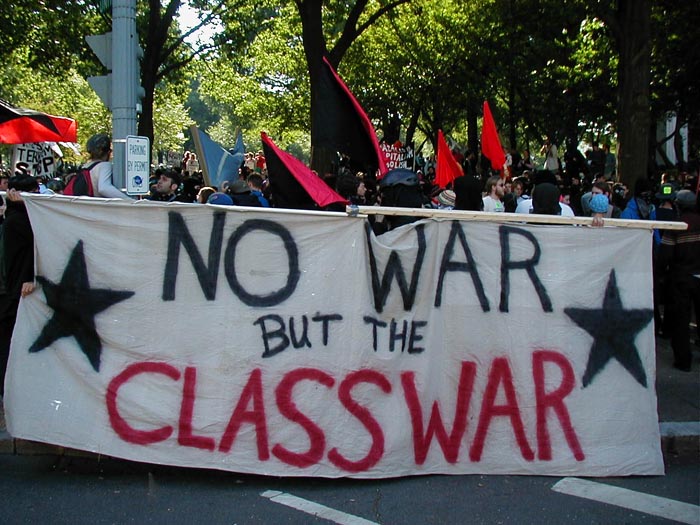
PART’s Perspective:
From a One-Day General Strike to a Protracted Struggle for Liberation
by Michael Novick, Anti-Racist Action-LA/People Against Racist Terror
The call has been raised for a general strike against war, ICE, high prices, and the violation of democratic norms on May 1, historically International Working Peoples’ Day or May Day. It is a follow-up to the growing sequence of No Kings rallies, and given that it is scheduled as a day of “no work, no school, no shopping” on a workday rather than a weekend, it represents a step up in militance, putting some teeth into the earlier rhetorical calls to “shut it down”.
Even though the call arises from the forces behind No Kings, like 50501 and Indivisible, who fit comfortably within the orbit of the mainstream Democratic Party, no US labor union or federation has endorsed the call. Some on the left have criticized it as pointless or futile for that reason. But organized labor — because of the debilitating effects of racism and anti-communism — represents a small minority of workers in the private sector in the US, and a not much larger share of government employees. For a general strike to have a significant impact, it would in any event have to extend far beyond the ranks of those currently in a trade union.
Many unions are hemmed in by contract language and “no-strike” clauses. A case in point is the settlement reached by the unions representing teachers, administrators and other education workers with the Los Angeles Unified School District, second largest in the country, just before a deadline for a strike on April 14. The teachers, clerks, and cafeteria workers, even though they have been strong and forthright in demanding that LAUSD protect students, staff and their families from ICE, voted to accept the deal that satisfied their key demands on staffing and pay, without going on strike.
The role of unions within the capitalist system, even the most progressive, is to get the best deal they can from their employers for their members at the lowest cost in lost pay due to work stoppages. A general strike independent of and outside the norms of business unionism and contractual bargaining may do a lot to revive class consciousness and stimulate a sense of working people’s power. Middle school, high school and college students are in a much clearer position to enforce a “no school” pledge than their teachers are.
The more justified criticism of No Kings and the May Day call is that they have not provided a framework or strategy for deep-rooted organizing, base-building and unification on the basis of class-conscious solidarity; nor have they called for the kind of thorough-going economic, social and political transformation the times demand. Their focus has been on Trump’s atrocities and inanities, and not on the system of empire, exploitation, environmental devastation and inequality that produced Trump and hoisted him to imperial power. They are operating on the assumption that a return to the status-quo-ante, the norms of prior times, is necessary, possible and sufficient.
The “Electoral Cliff” in 2032
The foolhardy nature of that supposition is underscored by the recent hand-wringing by pundits who fear that the Democratic Party is failing to sufficiently moderate its political positions. These “moderates” or “centrists” see the handwriting on the wall in the form of the 2030 census and the 2032 general elections, by which time a victory in the northeast, the west coast and the Great Lakes Midwest would no longer be sufficient to capture the presidency. Because of the population shift from those states, their Congressional delegations and electoral votes would be reduced and transferred to Arizona, Texas, Tennessee, Florida and the Carolinas.
Unmentioned in their argument that the Democrats need to move to the right to win, but underpinning it, is the reality that most of those states were part of the Confederacy, and that the GOP lock on those states, like that of the “Dixiecrats” on the ‘Solid South’ in times past, is based on white supremacy and voter suppression. Nor do they address the essentially undemocratic nature of the Electoral College, which magnifies the influence and impact of sparsely-populated and mostly white states (as does the US Senate).
Hope for change begins with recognizing that the fascist forces already wielding state power are deeply rooted in settler colonialism, institutionalized white supremacy, and empire and that we cannot go back to a mythical “norm”, but forward to a fundamentally different society and economy.
It Takes a Revolution to Defeat Fascism
Fascism, based in colonialism, was not defeated at the end of World War II but simply reintegrated into the US national security state, war machine, and corporate monopoly capitalist economy. Only a revolutionary dispossession of those forces and a liberation of oppressed and colonized people will defeat fascism and empire.
But the left needs to take at least one thing from the argumentation of the so-called moderates — they are looking well ahead, down the road not just to the ‘mid-term’ elections, or the 2028 presidential election, but six-plus years into the future; and they are proposing a strategy or at least a set of tactics beginning now, to change the shape of that future.
What would an anti-capitalist, anti-authoritarian, anti-imperialist left path forward to shaping the future look like? Start with the recognition that the working class that empowers, enriches and sustains the US empire and the billionaires who run it is not located only inside the US, but also globally. The problems of de-industrialization and capitalist globalization will not be solved by a race to the bottom through the use of child labor and slave labor inside the US, or by “beggar-thy-neighbor” tariffs and trade-wars (or shooting wars).
We need international and inter-communal labor solidarity, decolonization, environmental (and social) reparation, and social control of the means of production to meet human needs. Overturn imperialist unequal exchange and raise wages and living standards for all by expropriating the expropriators, the billionaires who have been financing and strategizing the turn towards neo-fascism internationally.
Domestically, we need to stand with migrant workers, sex workers, and incarcerated workers, and end racist and sexist differentials in pay affecting women, particularly Black women. We need to provide education, housing and health care as human rights, particularly reproductive and prenatal health care and paid parental leave. We need to reforest, restore agricultural soil through regenerative, organic processes, and replenish our aquifers.
We must speak to the justified mistrust of artificial intelligence and the opposition to the data centers being built to fuel it. We must address the well-founded fears that A-I will predominantly eliminate jobs, render human labor and creativity superfluous, and generate a new and costly arms race and battles with robots on the land and sea and in the air and space. These are pressing immediate realities, not a science fictional future, as shown by Trump’s request for a $1.5 trillion dollar annual military budget, and his effort to preempt regulation of A-I. We need, not simply a “Green New Deal,” but a transformation from an economy based on war and profit at the expense of humanity and the planetary eco-system, to one predicated on peace, solidarity and eco-socialism.
But to get to those goals, we need to build the base of solidarity relationships through shared and protracted struggle. We need to develop the capacity to organize “below the radar” in classrooms and workplaces, in prisons, and inside the military, and in all those arenas to organize the unorganized.
It may be too much to expect the organizers of May Day Strong to embrace the concept of a July Semi-Quincentennial Without Colonies, or endorse the Peoples’ Senate call for the July 4th National Mobilization Against Genocides in Atlanta GA (see https://spiritofmandela.org/news-events/july-4th-2026-mobilization-against-genocides-atlanta for more information), but May 1 protesters can and should as a step forward in that process.
We need interfaith movements, consciousness-raising groups, study circles, sex-positive education and respect for young people. We need to promote collective self-help and wellness, community defense and physical fitness, and to meet the human need for connection and self-worth. We cannot yield those issues to RFK Jr.’s conspiratorial MAHA, to the Christo-fascists, or to the manosphere.
We need to unite homeowners, renters, and people with no fixed abode. We need to unite students, farmers, consumers, and even nations burdened by debt for a jubilee; to unite “cowboys and Indians”, farmers and campesinos, rural and city-dwellers around protecting the land and water. We need to overturn and uproot white supremacy and identification with the Empire. And as we do so, we will increase the creative power of poor and working people the world over, and reduce the power of the oppressors and exploiters, our enemies, until we can eliminate them as a class by ending exploitation and oppression as a system.