
The ABCs of ACAB
Abolishing the Police, edited by Koshka Duff (Dog Section Press, 2021)
Reviewed by Heath Row
This 256-page paperback anthology edited by Koshka Duff, an assistant professor in the University of Nottingham’s department of philosophy (https://tinyurl.com/y29wu76v), collects a baker’s dozen essays and articles about reasons to abolish the police, methods and practices activists can consider, and possible outcomes.
The book, neither an activists handbook nor an academic text (though Michel Foucault is first mentioned on p. 11 and the book contains more than 50 pages of footnotes and bibliography), offers a welcome, accessible introduction to anti-police theory and practice, including police abolition and de-colonial criminology. The contributors to the anthology are very much scholars of activism and activist scholars.
Duff’s introduction to the anthology touches on university student protests, the unwarranted murders of Mark Duggan and Eric Garner, what kinds of communities are policed rather than protected, police complicity in structural racism, and the risks of maintaining the status quo. A June 21, 2026, article in The Economist reported that police killings in the United States are increasing even as murder rates fall. The police, like the prisons they feed, are murderers.
Readers of Turning the Tide and anti-racist activists are likely already somewhat sympathetic to many of the ideas and ideals featured in Abolishing the Police. As a reader and reviewer for this forum, I was most interested in the book’s consideration of structural racism and anti-racist activism within the context of police abolition.
Contributor Arianne Shahvisi suggests that the increasing activity and impact of law enforcement agencies such as Immigration Compliance and Enforcement (ICE) in the US indicate that our experiences with borders no longer primarily occur at airports and seaports—or, well, borders—but can become an everyday occurrence. Migrants are increasingly subject to surveillance, detection, and arrest in their homes, workplaces, schools, and the streets.
As ordinary citizens become involved in offering police or federal law enforcement “tips” about the potential immigration status of neighbors and community members, racial profiling and other “new opportunities for racism” increase. “While the legislation is officially intended to target irregular migrants, the discourse that does so is necessarily racist and therefore lacks specificity,” Shahvisi writes. “Citizenship is therefore no protection against the racism caused by everyday bordering… .” The essay also considers migrant-related criminality discourse, military imperialism, and the aftermath of settler colonialism.
Tom Kemp and Phe Amis explore the racial capitalism (as posited by Cedric Robinson, author of Black Marxism and Downtown Blues) that developed out of European colonialism. “Immigration controls are a historical product of post-colonial European statehood, developed to mobilise ‘race’ to restructure entitlements to ‘British’ wealth accrued during five centuries of enslavement and colonisation,” the authors write. “They are used to disavow claims of belonging by Black people and people of colour… .” Imperialist rhetoric, then, is grounded in white supremacy.
Tanzil Chowdhury’s all-too-brief piece builds on that slightly, considering the development of professional policing in parallel with early capitalism, the state’s desire to pacify the emergent working class, and the normalization of policing racialized communities. By framing subsets of society as inferior, imperial states legitimize domination.
Becka Hudson’s article, “Statues and Gangs,” resonates strongly with the recent egregious outcome of the Prairieland case in which participation in a book club and possession of leftist literature were presented as evidence of criminality. Hudson indicates that, increasingly, the police are agents of a “fascist panic” targeting racialized crime—and perhaps anti-fascist activism. The far right is galvanized by racialized crime, and in some countries, including the US, the police have been infiltrated by the far right—and racists. Law enforcement gangs within the Los Angeles County Sheriff’s Department and Los Angeles Police Department provide strong examples. ICE provides another.
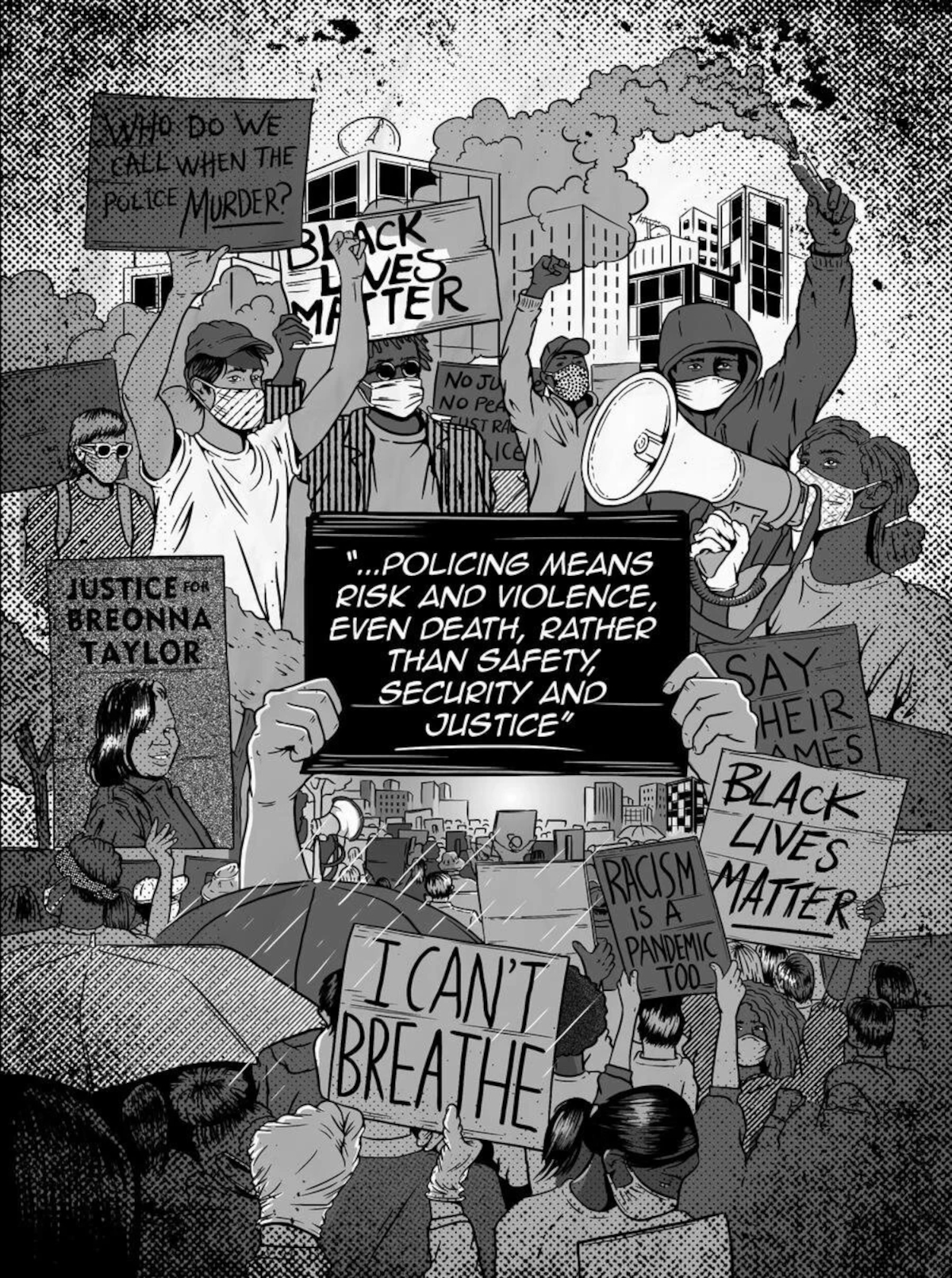
Focusing on the structural violence faced by Black Lives Matter activists, Eddie Bruce-Jones suggests that it’s a mistake to focus on murderous police as racist individuals, rather than as representative agents of an oppressive system. Doing so can distract activists from concentrating on more challenging but more effective structural and systemic change. (Bruce-Jones’s piece was originally published in the Los Angeles Review of Books in 2015.) And invoking the Black Panthers, Daniel Loick identifies two existing strategies for creating alternatives to state-inflicted violence: moving from criminal to social justice, and pursuing non-carceral responses to interpersonal harm.
The rest of the book is also worth reading and highly inspiring, even if the essays don’t focus primarily on racism. Decidedly hopeful, the last few contributions included in the volume concentrate on solutions, including practices individuals can undertake and engage in on an everyday basis to make impact in one’s immediate zone of influence and peer groups.
The topic of structural violence and police abolition is heavy and the crisis before us is real, but the situation isn’t hopeless. That’s important to remember even as the rights of citizens continue to erode and political activism is criminalized as terrorist activity.
My primary criticism of the book is that because the collection is neither an activists handbook nor an academic text, it’s kind of neither fish nor fowl. Neither purpose is fully served. Many of the pieces feel too short—and I would welcome longer form, more rigorous work from practically every single one of the contributors. Similarly, I’d welcome more activist case studies, tips, tricks, and advice.
It’s also worth noting that even with the book’s discussion of the Global North and South and migrant diaspora, the participating authors live in the United Kingdom, the Netherlands, the USA, and Germany. Regardless of where they might have come from—or where they might be going—that lends the text a largely western European or western point of view. Regardless, this is a global issue, and I applaud the book’s attention beyond the United Kingdom.
Dog Section Press (https://www.dogsection.org) is a London-based not-for-profit publisher and self-described “distributor of seditious literature.” Formerly publisher of the lively quarterly newspaper Dope Magazine—now published by the Solidarity Economy Association—the press concentrates on anarchist, feminist, and adjacent works.
This anthology, available in print for £8 or as a free PDF (https://tinyurl.com/yv87pd8u) was shortlisted for the Bread & Roses Award for Radical Publishing (https://breadandrosesprize.wordpress.com) in 2022. I obtained my copy from Freedom Press in the UK. (https://freedompress.org.uk)
Additional recommended reading: Police Abolition 101 zine, Manifesto for the Abolition of the Police pamphlet, Abolition Now! by the CR10 Publications Collective (AK Press, 2008), and Becoming Abolitionists by Derecka Purnell (Astra House, 2021).